Heritage Horticultural: Building a Demand Engine for a Premium Garden Management Business
Heritage Horticultural engaged Peatling Group to help the company to build a scalable demand generation capability. It wanted to industrialise what was working and use data to analyse decisions. Within five months, the business was on track to double its year-on-year gardening bookings and it had a pipeline of new corporate clients. As importantly, it has a repeatable strategy for driving more demand and providing additional supply — through a codified process for hiring high quality gardeners.
The Client
Heritage Horticultural is a premium garden management business operating across the Essex and Suffolk countryside. They specialise in matching skilled horticulturalists to high-value residential properties for ongoing maintenance—a relationship-driven, recurring-revenue model. The business had a loyal customer base and a strong reputation.
Heritage Horticultural wanted to drive more demand in a more predictable way and industrialise its approach to customer acquisition. It also felt it was important to have a process to smoothly onboard new gardeners as demand increased — so that it was never over-committed. The company engaged Peatling Group as a hands-on strategic partner to design and execute that capability. All actions described were done jointly by the client and Peatling Group — we are in daily active communication to ensure the best possible results and alignment.

A Data-Led Approach to Demand Generation
We built customer targeting from first principles. Using Land Registry transaction data, we identified a high number of properties within the company’s catchment area; both high value and close enough in proximity. AI was then used to scrub this dataset—removing commercial premises, urban addresses, and lower-confidence entries—producing a refined universe of genuinely high-probability prospects.
The client and Peatling Group together developed clusters of high-value properties grouped by postcode, with AI-optimised delivery routes. This allowed us to deploy marketing materials with a level of precision normally associated with digital advertising—but in a physical, tangible format suited to the target demographic. Thereby optimising return on investment and saving wasted postage, printing and time.
The cost-per-contact was a fraction of what a generic mailshot would have been, because every brochure reached a household with the right property profile.
Balancing Supply and Demand
A core challenge for any service business scaling on labour is that demand and supply must grow in tandem. Recruiting too slowly means turning away work; recruiting too fast creates idle capacity and cost pressure. Rather than just helping to drive demand and leaving the client to deal with how it fulfils additional work, Peatling Group and the company now manage both sides of this equation simultaneously.
We established a parallel recruitment programme. Analysing the market, we felt that many mainstream recruitment channels were ill-suited to the company’s specific operation. Instead, our process sources gardener candidates through various niche employer networks, targeted outreach in Facebook communities and other approaches — all at very limited or zero listing cost. Candidates were screened by the company, scheduled for trial days, and tracked through a shared pipeline. It has resulted in exceptionally high quality new staff members, who clients love.
The result was that Heritage could confidently take on new clients knowing the workforce was scaling alongside demand—rather than discovering capacity constraints after the fact.
Multi-Channel Execution: Consumer
We executed across several channels simultaneously, all informed by the data layer described above. The intent was to create multiple points of contact with prospective clients, each reinforcing the Heritage Horticultural brand in different contexts.
Targeted Mailshot
Over 1,000 brochures sent to curated addresses to postcode area adjacent to existing territories, where the company was not present. Every address selected from the AI-scrubbed property database.
Hand-Delivered Brochures
Hundreds of homes visited across multiple days. This allowed for on-the-ground intelligence gathering and verification of the address targets alongside high value in-person interactions with potential customers.
Review Management
Google rating lifted to a best in class rating through a structured review-gathering initiative, improving credibility for prospects researching the business online.
Creative Marketing
Wildflower seed packets sourced locally and left with businesses as a distinctive brand touchpoint. Brochure copy and positioning refined and updated.
Multi-Channel Execution: Corporate
In parallel, we developed a corporate client pipeline that had not been worked on systematically.
Venue Outreach
Direct outreach to almost 100 businesses including wedding venues, golf resorts, care homes, and luxury holiday lets across Essex and Suffolk.
In-Person Networking
On-the-ground visits to target towns, building relationships with local business owners and placing brochures in high-footfall locations.
New Contracts Secured
Calls and meetings with multiple venues which have led to new bookings.
Referral Programme
A formal referral scheme established with garden and interior designers.
Building the Brand
We took over Heritage Horticultural’s Instagram presence so the founder could focus his time on the most pressing matters. We doubled the following in a few weeks with our “Rent a brain” service. Content was created on location at client gardens—seasonal blooms, garden transformations, and behind-the-scenes reels. We also extended the brand presence to Facebook community groups across target areas, posting as Heritage Horticultural to generate leads directly.
A full-page advertisement was placed in local news. Local advertising opportunities were also explored at farm shops, delis, and garden centres.


Outcome
In parallel, the Heritage Horticultural Instagram audience was built from near-zero engagement to over 600 followers, a best in class Google rating, and a formal referral programme was established with third-party garden and interior designers.
Our Approach
This engagement exemplifies the Peatling Group model: an embedded partnership, not arm’s-length advisory or ‘coaching’ from the sidelines. Data and AI were used to sharpen targeting, speed up output, lower costs and reduce waste. Execution was hands-on—from printing address labels at the kitchen table to hand-delivering brochures across the Suffolk countryside. Supply and demand were managed as a single, interconnected system rather than treated as separate problems.
Next Steps: A Bespoke App
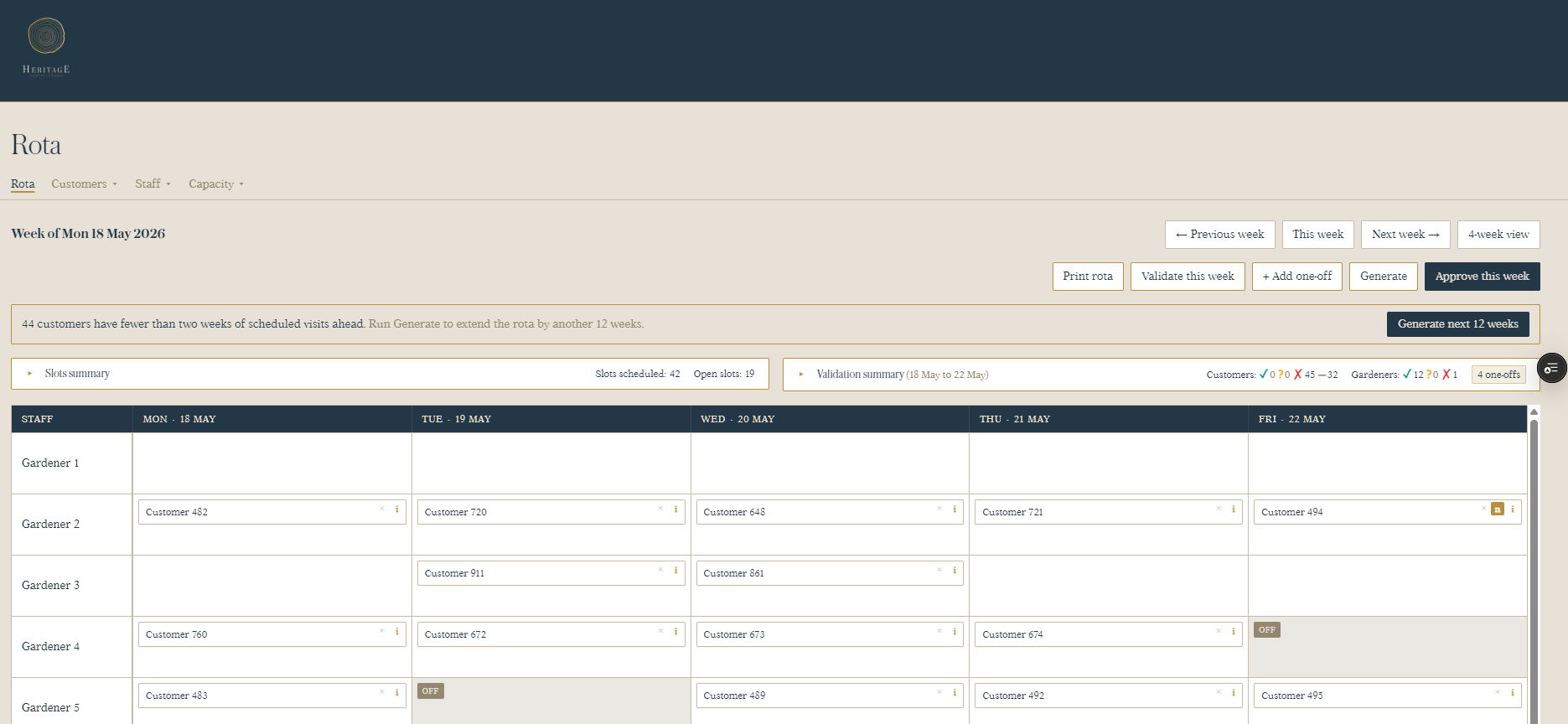
With demand growing and the workforce scaling alongside it, the next constraint was operational: scheduling, dispatch, and customer records were being managed in a spreadsheet that was struggling to scale. While it had long considered generic SaaS products to solve this, management did not want to shoe-horn the business into the design of a third party tool. Instead, management decided it should leverage the recent drop in software development costs to co-design and build a custom app, alongside Peatling Group. Together, we are building a bespoke application tailored to Heritage Horticultural’s exact operating model.
From concept eight weeks ago, the app is now beginning to play an important part in the company’s operations. It manages the customer database, scheduling of gardener visits, staff records, and the day-to-day coordination between office and field. In-built checks and balances ensure that all possible revenue is captured, and scheduling conflicts are kept to a minimum — a critical part of Heritage’s value proposition. Heritage retains ownership of the application and all source code.
Future phases will extend the app to support reporting, staff communication, and selective customer-facing functionality.